Dijkstra, and the shortest path
van Rossem is in and settled, and it was an intra-era fork: protocol version 11, no era change, transactions built exactly as before. Cardano is still in Conway. The next era on the roadmap is Dijkstra.
Edsger Dijkstra was a Dutch computer scientist, and if you have written any software at all you have used his work whether you knew it or not. Shortest-path routing, the semaphore, structured programming, the argument that ended up killing the goto statement. He worked things out on paper and mailed the results to colleagues by hand, hundreds of numbered manuscripts, for decades. He was also gloriously blunt: “Computer science is no more about computers than astronomy is about telescopes.”
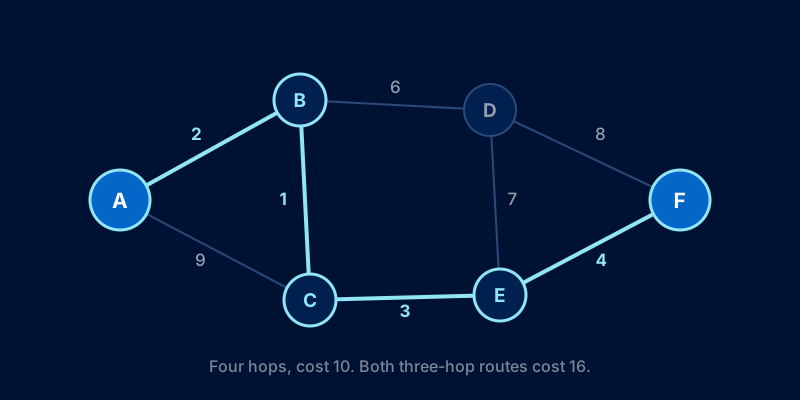
The shortest-path work is the bit you use most without noticing. Every time a maps app routes you somewhere it is running a descendant of it: A* is Dijkstra with a hint about which way the destination lies, and the contraction hierarchies that make planet-scale routing fast enough to feel instant are, in the author’s own description, Dijkstra’s algorithm with one extra rule. Seventy years on, the thing has not been replaced so much as given better shoes.
The thread running through all of it was that correctness should be proved. “Testing shows the presence, not the absence of bugs” is his. He thought programs should be derived from arguments about what they must do, and he was unfashionably insistent about it at a time when the industry was quite happy shipping and seeing what broke.
The era itself carries Ouroboros Leios, the throughput redesign, along with Plutus v4 and the first of the account features. Leios is a substantial reworking of how blocks move through the network, and it is being formally modelled and audited before it ships rather than after.
Which makes Dijkstra a reasonable name to hang on it. Cardano’s whole approach (peer review before code, formal methods, the slow route) is the position Dijkstra spent his career arguing for, and losing at the time. Naming the eras after Byron, Shelley, Goguen, Basho, Voltaire, Conway was a nice arc through poets and logicians. Dijkstra lands somewhere more pointed: the person who insisted the discipline should be a discipline.
The shortest path is not always the fastest one to start walking.