The Lindy effect
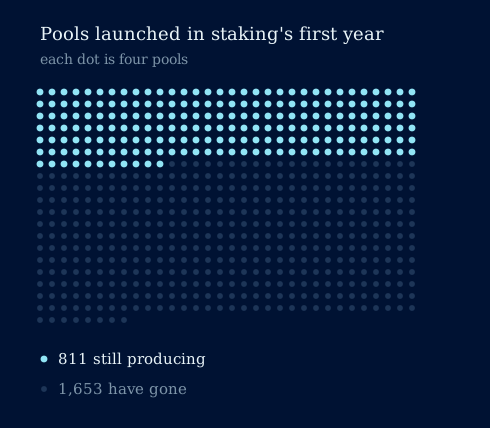 Of the 2,464 pools that began producing in staking’s first year, 811 are still going. The rest stopped. Pool registration and status data via Koios, epoch 647.
Staking rewards are noisier than most people realise.
From one epoch to the next a delegator’s reward moves by around a third either side of the average. Block production is a lottery weighted by stake, and over five days luck dominates everything. A one percent margin, by comparison, changes a reward by one part in a hundred. On ten thousand ADA that is about two ADA a year, roughly a tenth of what the same delegation swings between two ordinary epochs.
The Lindy effect holds that for things which do not age (ideas, technologies, institutions) life expectancy is proportional to current age. What has lasted longest is likeliest to persist. It sounds like a trick until you notice it is only survivorship, stated forwards.
Cardano staking suits it unusually well, because switching costs nothing. No lock-up, no unbonding, no penalty. A delegator can leave at any moment, for any reason, and plenty do. Which means a pool’s lifetime block count measures something other than size. It is the accumulated record of many thousands of independent decisions to stay, made by people who could have left that morning and chose not to. Two of ours sit in the top ten by lifetime blocks.
We have built the ADAvault operation around reliability and consistency, we are obsessive about it. And you can see that in our track record on chain.